
Course Description
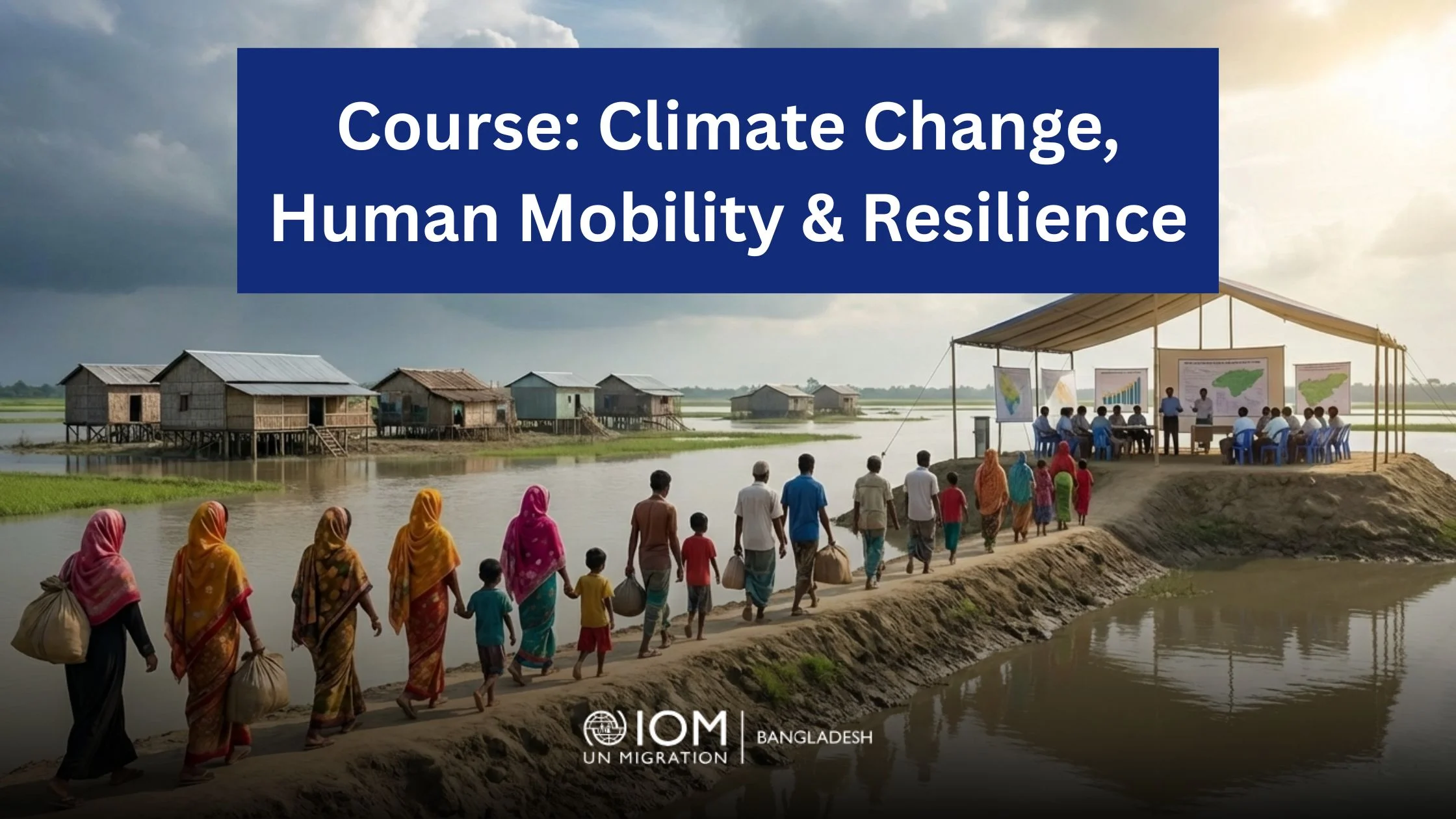
This course is designed to bridge the gap between high-level policy and field-level practice by equipping participants with the knowledge and tools necessary to manage climate-induced migration and displacement. It explores the complex nexus of climate change, human mobility, and resilience, specifically within the context of Bangladesh. Participants will learn to implement rights-based and gender-responsive strategies that promote long-term resilience and durable solutions for affected populations.
Purpose
The primary goal of this course is to provide practitioners with a practical framework for addressing displacement caused by sudden and slow-onset climatic events. It aims to empower stakeholders to move beyond “passive” assistance toward proactive management that includes preventing displacement where possible, managing it effectively when it occurs, and securing sustainable, dignified futures for displaced individuals.
Learning Objectives
By the end of this course, learners will be able to:
-
Analyze Policy Frameworks: Gain a deep understanding of national strategies like the National Adaptation Plan (NAP) 2023–2050 and the National Strategy on Internal Displacement Management 2021.
-
Apply Global Standards: Align local displacement management activities with international frameworks, including the Sustainable Development Goals (SDGs) and the Sendai Framework for Disaster Risk Reduction.
-
Implement Gender-Responsive Measures: Identify gender-specific risks and integrate gender responsiveness into displacement projects to protect the most vulnerable.
-
Identify Durable Solutions: Evaluate and implement modalities for durable solutions, including voluntary return, local integration, or planned relocation/resettlement.
-
Champion Locally Led Adaptation (LLA): Apply the eight principles of LLA to ensure that local communities have agency and decision-making power over their own resilience efforts.
Target Learners
This course is specifically tailored for:
-
Practitioners and Sectoral Program Developers: Those working in climate action, disaster risk reduction (DRR), and migration management.
-
Government Officials and Policy Makers: Individuals responsible for integrating mobility into national and local adaptation planning.
-
Local Authorities and Community Leaders: Stakeholders at the forefront of implementing evacuation protocols and community-led DRR initiatives.
-
NGO and Humanitarian Workers: Personnel involved in providing emergency assistance and psychosocial support to displaced families.
Course Benefits
-
Practical Tools: Provides actionable activity ideas, such as displacement tracking, mobility mapping, and climate-resilient livelihood training.
-
Strategic Alignment: Ensures that participants’ work is consistent with the latest national policies and global best practices.
-
Resilience Focus: Moves beyond immediate relief to focus on building “institutional legacies” and community self-reliance.
Prerequisites
While there are no strict educational prerequisites, it is recommended that participants have:
-
A basic understanding of climate change concepts and disaster management terminology.
-
Professional or volunteer experience working with vulnerable or displaced populations in Bangladesh.
Affiliation and Attribution Declaration

Course Affiliation and Source Material This course is developed in affiliation with the International Organization for Migration (IOM) and is fundamentally based on the Training Manual on Climate Change, Human Mobility and Resilience (2025).
Course Features
- Lectures 11
- Quizzes 1
- Duration 6 Hours
- Skill level All levels
- Language English
- Students 199
- Certificate Yes
- Assessments Self

Leave A Reply
You must be logged in to post a comment.








2 Comments
Nowadays all of the countries people, and also peoples around the word suffers for many Disaster.
Most of them don’t know how to react. what should they do when that happened. I personally learned many specific things during this course. Knowing the disaster management is one kind of most informative, and useful thing. I can not understand how management happens when disaster comes to a country. I also learned how to react that time, managing it effectively when it occurs.
From here I also learned displacement tracking, mobility mapping, and climate-resilient livelihood training.
It is very helpful course for us for knowing about climate change.