
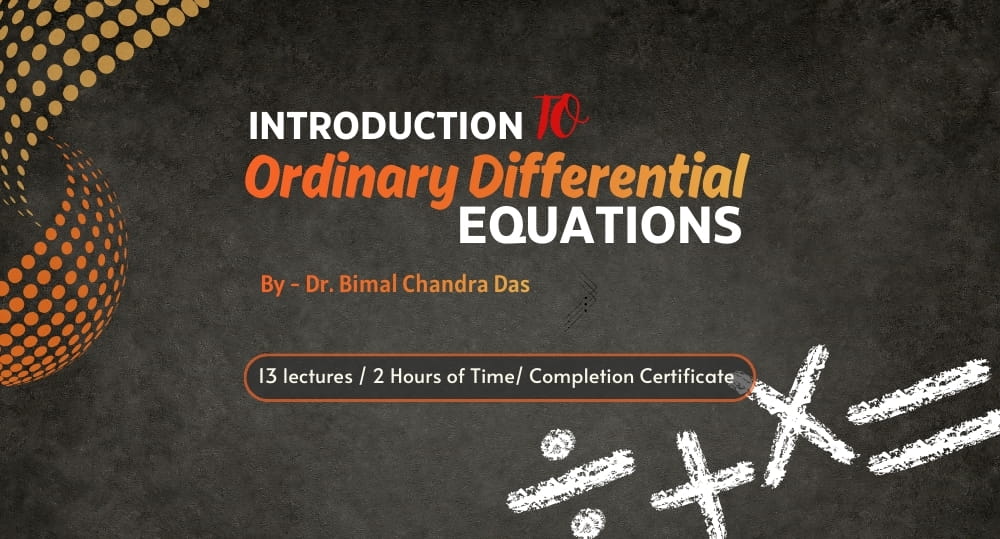
Course Description
A differential equation (D.E.) is an equation which involves a function and one or more of its derivatives. It is known as the most important mathematical course Introduction to Ordinary Differential Equations for any discipline. It expresses the relationship between the function’s values and its rates of change. D.E. have a wide range of applications in various fields such as Physics, engineering, biology, economics. D.E. is also used in motion of any objects, developing video games, physical growth of animals, and also to calculate any rate of change in real life problems. It will be very helpful and easy to understand the course properly if the learners have the fundamental knowledge of calculus. Ordinary Differential Equations (ODEs) form the mathematical backbone for understanding how things change. At its core, a differential equation represents a relationship between a continuously varying quantity (a function) and its rates of change (its derivatives). Because the natural world is constantly in flux, ODEs are universally recognized as one of the most critical mathematical tools across virtually every scientific and technical discipline.
This course Introduction to Ordinary Differential Equations serves as a comprehensive bridge between theoretical calculus and real-world applied mathematics. Students will explore how to translate dynamic systems into mathematical models, utilizing ODEs to describe phenomena such as the physical growth of biological organisms, the trajectory and motion of objects in physics, market fluctuations in economics, and even the programmed physics engines behind modern video games.
Throughout the course, learners will journey from the fundamental formulation of basic differential equations to mastering advanced analytical techniques for solving complex $n$-th order linear equations. Because this course heavily relies on manipulating derivatives and integrals, a solid fundamental understanding of calculus is a highly recommended prerequisite to ensure a smooth and successful learning experience.
Introduction to Ordinary Differential Equations Course Objectives
- Define ordinary differential equations and accurately identify their order and degree.
- Formulate mathematical models to represent real-world rates of change.
- Solve first-order, first-degree ODEs using the variable separation method.
- Evaluate and solve first-order homogeneous and non-homogeneous ODEs.
- Compute solutions for $n$-th order linear ODEs with constant and variable coefficients.
Target Learners of Introduction to Ordinary Differential Equations Course
This course is designed for undergraduate students in STEM fields (Science, Technology, Engineering, and Mathematics), economics majors, aspiring game developers, and any analytical thinkers looking to understand the mechanics behind dynamic systems and predictive modeling.
Requirements
A solid, fundamental knowledge of calculus—specifically differential and integral calculus—is strictly required. Students must be comfortable with taking derivatives and evaluating integrals to successfully navigate and solve the equations presented in this course.
What More to Expect?
- 13 complete lessons within 2 hours of time
- Quizzes to assess learning from the course
- Option to discuss problems on the lessons through the course forum
- Certificate
GoEdu Learner’s Manual
Course Features
- Lectures 13
- Quizzes 1
- Duration 2 Hours
- Skill level All levels
- Language Bengali
- Students 0
- Certificate Yes
- Assessments Self